

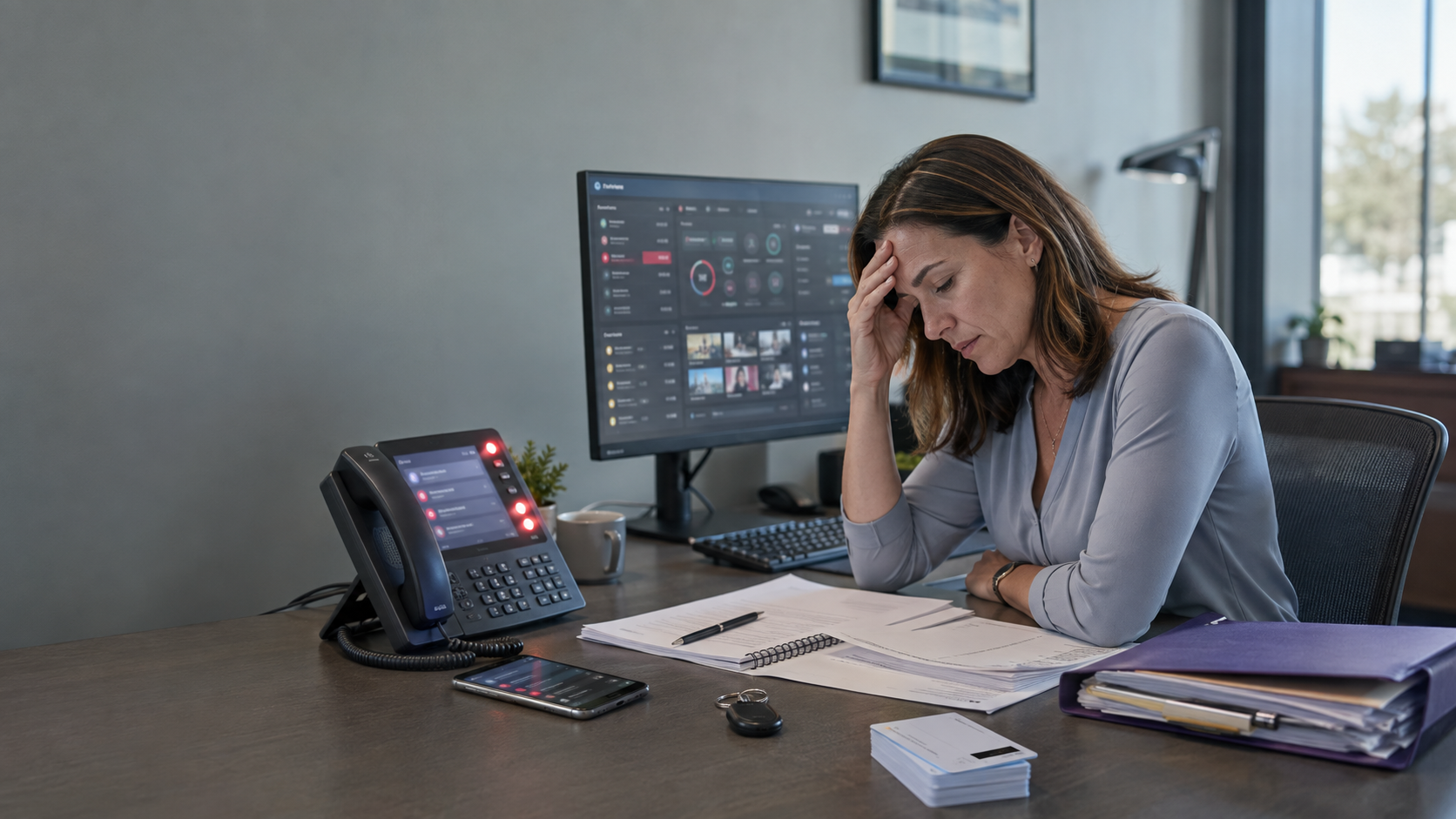
Community association managers are being asked to do more with less. They manage board expectations, resident communications, vendors, budgets, maintenance, compliance and emergencies, often across multiple communities. At guard-gated properties, they also become the default point of contact for a complicated security operation involving residents, visitors, guards, gate vendors, access credentials, license plates and multiple technology platforms.
That security workload is easy to underestimate because it rarely appears as one large assignment. It arrives throughout the day as a stream of small requests:
- A resident cannot access the visitor-management app.
- A new vehicle needs to be registered.
- A guest did not receive an electronic pass.
- A vendor needs recurring access during approved hours.
- A former resident’s credential must be deactivated.
- A gate is not opening, and nobody knows whether the problem is the hardware, credential, network or software.
- A board member wants information related to a recent security incident.
- A resident wants to know why a visitor was denied entry.
Each request may take only a few minutes. Collectively, they fragment the manager’s day, generate after-hours interruptions and pull attention away from work that actually requires professional judgment.
Community-manager burnout is therefore not only a staffing or workplace-culture problem. For gated communities, it is also a security-technology and operating-model problem.
The community-management workforce is already under pressure
Recent industry research shows how serious the capacity problem has become.
The Foundation for Community Association Research surveyed 287 industry professionals across 38 states and Washington, D.C. Its Human Side of Community Management report found that:
- 84% encounter emotionally charged situations at least several times a week.
- 71% report moderate-to-severe professional burnout.
- 59% say work-related stress has increased during the past three years.
- 38% have seriously considered leaving community management because of stress, burnout or emotional exhaustion, while another 42% have considered it occasionally.
When respondents were asked what would most improve workforce well-being and retention, reduced workload was the leading response. More staff support and clearer boundaries also ranked prominently.
CINC Systems’ 2026 State of the Industry Report reinforces the capacity challenge. Among community association management executives surveyed:
- 51% said they had open positions they were struggling to fill.
- 56% rated community-manager burnout at seven or higher on a ten-point scale.
- 53% of community managers rated their own burnout at seven or higher.
The implication is straightforward: management companies cannot scale sustainably if each additional community creates a proportional increase in repetitive administrative work.
Why security administration becomes management work
Security technology is often purchased as though the operating responsibility ends once the gate, camera or access-control system is installed. In reality, installation begins an ongoing administrative process.
Every system depends on accurate information about residents, household members, vehicles, credentials, visitors and vendors. Those records constantly change as people move, replace vehicles, hire caregivers, invite recurring service providers or lose access credentials.
When systems are disconnected, the manager may need to update the same information in several places. When residents do not understand the technology, they call management. When the gate malfunctions, management coordinates among the guard company, installer and software provider. When the board requests an incident review, management helps identify which authorized party should retrieve the appropriate records.
The manager becomes the human integration connecting systems and organizations that do not communicate effectively with one another.
That is not the best use of a community manager’s time.
The hidden cost is interruption, not just hours
The security workload should not be measured only by the total time spent answering access-related requests. Its larger cost is fragmentation.
A manager may be preparing a board packet, reviewing a contract or addressing a sensitive resident matter when an urgent gate issue appears. Because access problems affect whether a resident, visitor or vendor can enter the property, they tend to demand immediate attention.
This creates several forms of operational cost:
Lost focus
Frequent interruptions make complex work take longer and increase the likelihood of errors.
After-hours pressure
Residents often expect access problems to be resolved immediately, even when they occur outside normal management hours.
Preventable conflict
A missed visitor authorization or deactivated credential can quickly become a resident complaint, board escalation or confrontation at the gate.
Unclear accountability
When several vendors are involved, the manager may spend more time determining who owns the problem than resolving it.
Reduced portfolio capacity
Management companies cannot assign more communities to a manager if operational complexity consumes the manager’s available time.
The business issue is not simply whether security administration occupies a certain percentage of the workweek. It is whether constant security-related interruptions prevent managers from serving boards and residents effectively.
Better technology should remove administration, not relocate it
Modern visitor management and access control can reduce the burden, but only when the technology is designed around the complete operational workflow.
Replacing a paper visitor list with a digital system does not create much value if the manager still has to answer every registration question manually. Adding license plate recognition does not eliminate work if vehicle records are inaccurate or every investigation requires manual cross-referencing. Introducing mobile credentials does not improve operations if onboarding and resident support remain unmanaged.
Effective security technology should reduce management work through capabilities such as:
- Resident self-service for visitors, vehicles and household information
- Automated synchronization with the property-management system
- Electronic visitor passes and automated arrival notifications
- Time-limited and recurring vendor permissions
- Automated credential activation and expiration workflows
- Clear roles and permissions for managers, guards and board members
- Searchable visitor, vehicle and access histories
- Standardized reports for authorized users
- Automated alerts for meaningful exceptions
- Integrated support for managers and residents
The objective is not merely to digitize the existing process. It is to remove unnecessary steps, duplicate entry and avoidable human intervention.
The next opportunity is specialized security operations support
Technology alone will not resolve every situation. Residents will still need help. Exceptions will still occur. Hardware, software and guard operations will still intersect.
That creates an opportunity for a specialized security operations function that works across the community’s systems and vendors.
Instead of requiring the community manager to serve as the security help desk, a trained operations team could handle routine tasks such as:
- Resident onboarding and application support
- Visitor-registration and electronic-pass assistance
- Approved vehicle, credential and household updates
- Move-in and move-out access processing
- Vendor and recurring-visitor administration
- Initial troubleshooting and issue classification
- Coordination with guards, integrators and technology providers
- Status communication through resolution
- Routine operational reporting for authorized community personnel
Sensitive decisions would remain with the HOA, management and other authorized parties. The operations team would not determine community policy or independently release protected security information. Its purpose would be to execute documented processes, resolve routine requests and escalate matters requiring judgment.
This creates a more appropriate division of labor:
Security specialists manage repetitive security administration. Community managers focus on the resident, board and operational decisions that require professional judgment.
A better economic argument for modern security technology
The traditional case for visitor management, access control and license plate recognition emphasizes stronger security and faster entry. Those benefits remain important, but management capacity deserves equal attention.
The more strategic question is:
How much management time can the community recover by integrating security systems, enabling resident self-service and providing specialized operational support?
For an individual community, recovered time can improve responsiveness and reduce frustration. For a management company, the value can be much larger. A repeatable security operating model can help the company support more communities per manager without degrading resident service.
It can also reduce the need for every manager to become an expert in several visitor-management platforms, gate systems, credential technologies and security-vendor relationships.
What boards and management companies should evaluate
When assessing security technology, decision-makers should look beyond the feature list and ask how the system affects day-to-day management work:
- Can residents complete routine visitor and vehicle tasks without contacting management?
- Does resident information synchronize with the community’s system of record?
- Who assists residents when they cannot use the application or credential?
- How are move-ins, move-outs and credential changes administered?
- Can vendor access be governed by schedules and expiration rules?
- Who owns an issue when hardware, software and gate operations intersect?
- Which reports can authorized users generate without manual data reconstruction?
- What happens after normal management hours?
- Can the system document requests, changes and escalations from beginning to resolution?
- Does the technology measurably reduce the manager’s workload?
The final question may be the most important. A security platform should not become another system the community manager must administer. It should remove work from the manager’s desk.
Security technology should give managers capacity back
Community managers will always play an important role in gated-community security. They understand the community, execute board direction and provide the judgment required when policies, residents and real-world situations collide.
But they should not have to spend their days resetting access, correcting duplicate records, tracking down gate vendors, explaining routine visitor workflows or determining which company should respond to a malfunction.
The strongest security operating model combines integrated technology, resident self-service, clearly defined responsibilities and specialized support. That model does more than improve the gate. It gives community managers time and attention back.
In an industry facing persistent burnout, staffing shortages and rising service expectations, that recovered capacity may be one of the most valuable outcomes security technology can deliver.