

If you’re researching EntranceIQ reviews, you’re likely evaluating software for your HOA, gated community, country club, or master-planned community.
EntranceIQ has built a modern platform focused on visitor management, gate operations, resident access, visitor kiosks, and community entry.
For communities looking to replace an aging gate system or modernize the arrival experience, EntranceIQ may be an appropriate platform to evaluate.
The more important question, however, isn’t whether EntranceIQ is a good platform.
It’s whether it’s the right platform for your community—not only for today’s needs, but for where your community is headed over the next several years.
At a Glance
EntranceIQ may be a good fit if your community:
- Primarily wants to modernize gate operations
- Is focused on improving visitor processing and resident entry
- Wants a modern visitor kiosk experience
- Is looking for a streamlined visitor management platform
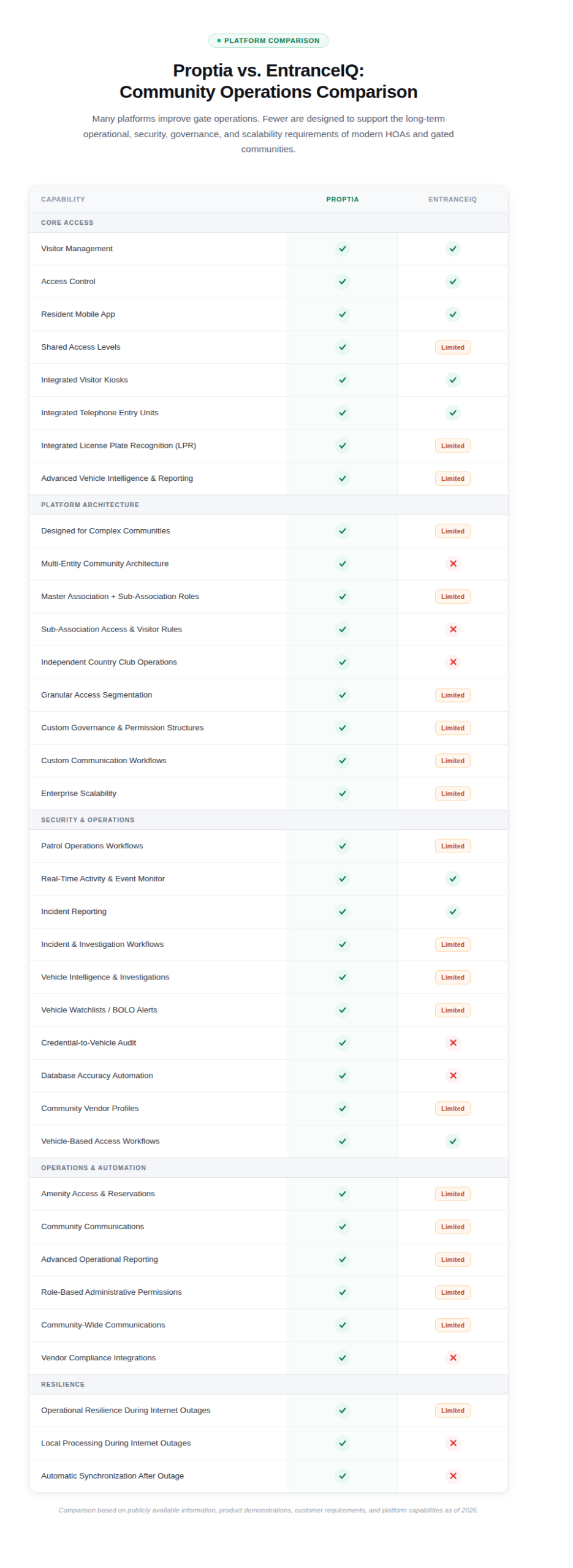
Proptia may be a better fit if your community:
- Wants to manage both the entrance and the broader day-to-day operations of the community
- Requires advanced security workflows and operational reporting
- Has multiple entrances, associations, or operating entities
- Needs connected resident, visitor, vehicle, vendor, and access control data
- Is looking for a platform that can continue evolving as operational needs change
Both platforms solve important problems.
The difference isn’t simply the list of features.
The difference is the operational philosophy behind the platform.
Beyond the Gate: Two Different Approaches to Community Operations
One of the things that stood out to us while evaluating EntranceIQ wasn’t a specific feature.
It was the philosophy behind the platform.
EntranceIQ appears to approach community operations from the perspective of the entrance.
That’s not a criticism.
For many communities, that’s exactly where modernization should begin.
The entrance is where residents arrive.
It’s where visitors check in.
It’s where vendors gain access.
It’s where security personnel spend much of their day.
Making those interactions faster, simpler, and more secure creates real value for the community.
EntranceIQ has invested heavily in improving that experience.
As we evaluated the platform, however, we kept coming back to a different question.
Should the gate be the center of your software strategy—or the beginning of it?
Because once someone enters the community, the work isn’t finished.
Residents continue moving throughout the property.
Visitors access amenities.
Vendors perform work.
Vehicles enter and leave throughout the day.
Security personnel investigate incidents.
Managers answer resident questions.
Boards review operational reports.
Those activities all depend on information created at the entrance.
The question becomes what happens to that information next.
Does it simply record who entered the community?
Or does it become connected to resident records, vehicle information, access control, reporting, investigations, vendors, and community operations?
That’s one of the biggest philosophical differences we see between platforms.
Some platforms are designed to optimize the entrance.
Others are designed to connect the entrance with everything happening throughout the community.
Neither approach is inherently right or wrong.
The better fit depends entirely on what your community expects the software to become over the next five to ten years.
What We Believe Communities Should Really Be Evaluating
One of the biggest mistakes we see during software evaluations is comparing platforms almost entirely on features.
Does it have a mobile app?
Does it support visitor kiosks?
Does it integrate with access control?
Does it offer license plate recognition?
Those are all important questions.
They’re just rarely the questions that determine whether a community is still happy with the platform three or five years later.
The better evaluation often starts one level deeper.
Instead of asking what features exist today, ask how the platform helps your community operate tomorrow.
For example…
When a resident updates their vehicle…
Does that information automatically become available to security personnel?
When a vendor is approved…
Can that information be used throughout the platform without entering it multiple times?
When an incident occurs…
Can management quickly understand the relationship between the resident, visitor, vehicle, credential, and access history?
When a board requests reporting…
Can the information be generated from a single source of truth, or does it require pulling data from multiple systems?
Those questions aren’t always obvious during a product demonstration.
They’re the questions communities begin asking months after implementation.
Another important consideration is flexibility.
Every gated community operates differently.
Some have a single entrance.
Others have multiple guardhouses.
Some have staffed gates.
Others rely primarily on resident self-service.
Some communities prioritize visitor management.
Others place greater emphasis on resident access control, patrol operations, reporting, or vehicle management.
The software should be flexible enough to support those operational differences without forcing the community to change how it operates.
Finally, consider the platform’s long-term vision.
Technology continues to evolve.
Resident expectations continue to evolve.
New access technologies emerge.
Security requirements change.
The best platforms aren’t simply those with the longest feature list.
They’re the platforms built to adapt alongside the communities they serve.
Ultimately, we believe communities should evaluate software less like a checklist…
…and more like a long-term operational investment.
Because replacing community software isn’t something most HOAs want to do every few years.
The right platform should continue delivering value long after the initial implementation is complete.
A Decade of Learning From Real Communities
Every gated community has its own way of operating.
Some communities have one entrance.
Others have multiple guardhouses.
Some rely on gate attendants.
Others are primarily resident self-service.
Some have a few hundred homes.
Others manage thousands of residents, visitors, vendors, and vehicles every day.
On the surface, they all look similar.
Behind the scenes, they’re anything but.
That’s one of the reasons community software continues to evolve.
Over the past decade, we’ve had the opportunity to work alongside hundreds of gated communities across North America.
During that time, Proptia has processed millions of visitor registrations, resident access transactions, vehicle events, vendor entries, and other operational activities.
Every one of those interactions represents a real community solving a real operational challenge.
Some communities wanted to reduce gate congestion.
Others needed stronger vehicle investigations.
Some were trying to simplify resident management.
Others wanted more flexibility around access control, reporting, or community communications.
Many of the capabilities in Proptia today weren’t built because they sounded good on a product roadmap.
They were built because community managers, security teams, and boards repeatedly encountered the same operational challenges and asked us to solve them.
That’s one of the advantages of experience.
Over time, software stops becoming a collection of independent features.
It becomes a collection of lessons learned.
Lessons about how communities actually operate.
Lessons about how residents use technology.
Lessons about where administrative work can be automated.
Lessons about how security teams investigate incidents more efficiently.
Lessons about what information boards actually need to make better decisions.
When evaluating any platform—including EntranceIQ—we believe it’s worth asking not only what the software can do today, but also why it was built that way.
Software reflects the experiences that shaped it.
The more communities a platform serves, the more opportunities it has to learn, improve, and adapt to the real-world challenges that communities face every day.
That’s difficult to measure on a feature checklist.
But it’s often one of the biggest differences communities notice after they’ve been using a platform for several years.
Why Connected Data Matters
At first glance, community software can appear to be a collection of independent features.
Visitor management.
Access control.
License plate recognition.
Vendor management.
Resident management.
Reporting.
Communications.
But the real value isn’t found in those individual capabilities.
It’s found in how they work together.
For example, imagine a vehicle enters the community.
That single event might also be connected to:
- A resident profile
- A visitor authorization
- A mobile credential
- A vendor appointment
- An access control event
- A security investigation
- A patrol observation
- An operational report
Individually, each piece of information has value.
Connected together, they provide context.
That’s what helps communities make better operational decisions.
Instead of searching multiple systems for answers, managers, security personnel, and administrators can understand the complete picture from a single platform.
That connected view also reduces duplicate data, minimizes administrative work, and improves the accuracy of community records over time.
It’s one of the reasons we encourage communities to think beyond individual features.
Because software shouldn’t simply collect information.
It should connect information.
And when information is connected, it becomes significantly more valuable to everyone responsible for operating the community.
Looking Beyond Today’s Feature Checklist
Feature comparisons are an important part of every software evaluation.
They help identify whether a platform supports the capabilities your community needs today.
But feature checklists rarely tell the entire story.
A better evaluation asks questions that aren’t always obvious during a demonstration.
How flexible is the platform?
Can it adapt as our community grows?
Will it support future operational requirements without requiring another software migration?
How easily can information move throughout the platform?
Will new technologies integrate cleanly as they become available?
Does the platform reduce administrative work—or simply digitize it?
Perhaps the most important question is this:
Will this software still be the right fit five or ten years from now?
Communities evolve.
Technology evolves.
Resident expectations evolve.
The software supporting your community should be built with that reality in mind.
That’s why we believe the best software decisions aren’t made by comparing feature lists alone.
They’re made by understanding the long-term vision, architecture, and operational philosophy behind the platform.
Those are the qualities that continue delivering value long after implementation is complete.
Conclusion
EntranceIQ has built a modern platform that helps communities improve visitor management and gate operations.
For communities primarily focused on creating a faster, more efficient entrance experience, it may be an excellent solution to evaluate.
At the same time, every community should consider what role they expect their software to play over the coming years.
Will it primarily manage activity at the entrance?
Or will it become the operational platform connecting residents, visitors, vehicles, vendors, access control, reporting, security, and day-to-day community operations?
Neither approach is universally right.
The answer depends on your community’s operational goals, complexity, and long-term vision.
Our recommendation is simple.
Look beyond the feature checklist.
Understand the philosophy behind each platform.
Evaluate how the software has evolved.
Consider how it will adapt as your community changes.
Then choose the platform that best aligns with the way your community operates—not just today, but for years to come.
FREQUENTLY ASKED QUESTIONS
Is EntranceIQ a good choice for HOAs and gated communities?
What should I compare besides visitor management features?
Visitor management is only one part of operating a modern community.
Communities should also evaluate:
- Platform architecture
- Access control
- Security workflows
- Governance flexibility
- Vehicle intelligence
- Operational reporting
- Integrations
- Community communications
- Long-term scalability
These capabilities often become increasingly important as a community grows.
Why is platform architecture important?
Every HOA operates differently.
Some communities include multiple neighborhoods, sub-associations, independent country clubs, commercial properties, or multiple governing bodies operating behind the same gates.
Choosing software with a flexible architecture helps ensure the platform can adapt as the community evolves rather than requiring operational compromises.
How important are software integrations?
Modern communities often rely on multiple technologies, including property management software, access control systems, telephone entry units, visitor kiosks, vendor compliance platforms, security systems, and communication tools.
Choosing a platform with a flexible integration strategy can help reduce duplicate data entry and improve operational efficiency as technology requirements evolve.
Is EntranceIQ or Proptia better?
There isn’t a single answer for every community.
EntranceIQ may be an appropriate solution for communities primarily focused on improving gate operations and visitor processing.
Communities seeking a broader community operations platform that supports governance, security operations, reporting, multi-entity management, operational workflows, and long-term scalability should carefully evaluate how Proptia’s architecture aligns with those objectives.
Should I evaluate the gate or the entire community operation?
The entrance is one of the most visible parts of any gated community, but it’s only one component of daily operations. When evaluating software, communities should consider not only how efficiently the platform manages the gate, but also how it supports residents, visitors, vehicles, vendors, amenities, reporting, security operations, and long-term community management. The goal is to choose software that continues delivering value well beyond the entrance.
What are the best alternatives to EntranceIQ?
Is a modern visitor kiosk enough for most communities?
Visitor kiosks are an excellent way to improve the resident and guest experience at the entrance.
However, many communities eventually expand their operational requirements to include resident access control, vehicle management, vendor management, patrol operations, reporting, amenity access, and community communications. Selecting software that can support those future needs may reduce the need for another software migration later.
Does License Plate Recognition (LPR) matter when choosing community software?
Yes—but communities should evaluate more than whether a platform simply supports license plate recognition.
The more important question is how vehicle information is used throughout the platform. Can it improve investigations, reporting, resident access, visitor management, security workflows, and operational decision making? The greatest value comes from transforming vehicle data into operational intelligence.
What happens if our community's needs change after implementation?
Community operations rarely remain static.
Boards introduce new policies, security expectations evolve, amenities expand, and resident expectations change over time. One of the most important questions during any software evaluation is whether the platform can continue supporting those operational changes without requiring a complete replacement.
How do I choose the right visitor management platform for my HOA?
Start by looking beyond today’s requirements.
Consider where your community will be in five or ten years.
Evaluate how each platform supports governance, reporting, integrations, security workflows, operational flexibility, and future growth—not just visitor management. The right software should become the operational foundation of your community, not simply a tool for processing visitors.
Why do communities replace visitor management software?
Communities rarely replace visitor management software because it can no longer process visitors.
More often, they replace it because their operational requirements have grown beyond what the platform was originally designed to support. As communities evolve, they frequently require stronger reporting, governance, integrations, access control, security workflows, and operational flexibility. Choosing software that can grow alongside the community may help avoid another platform migration in the future.
Get in Touch
See how Proptia transforms gate operations into a complete community operations platform.
Schedule a Demo Now!