

Quick Answer
A gated community visitor management and access control RFP is a structured request that helps an HOA compare potential solutions for managing residents, guests, vendors, vehicles, gates, and community access. A good RFP focuses on the community’s operational requirements and desired outcomes while separating software requirements from installation, hardware, and contractor requirements.
The goal is not to create the longest RFP possible. It is to give qualified providers enough information to recommend the right solution and give the HOA a fair way to compare those proposals.
Download the Free Editable HOA RFP Template
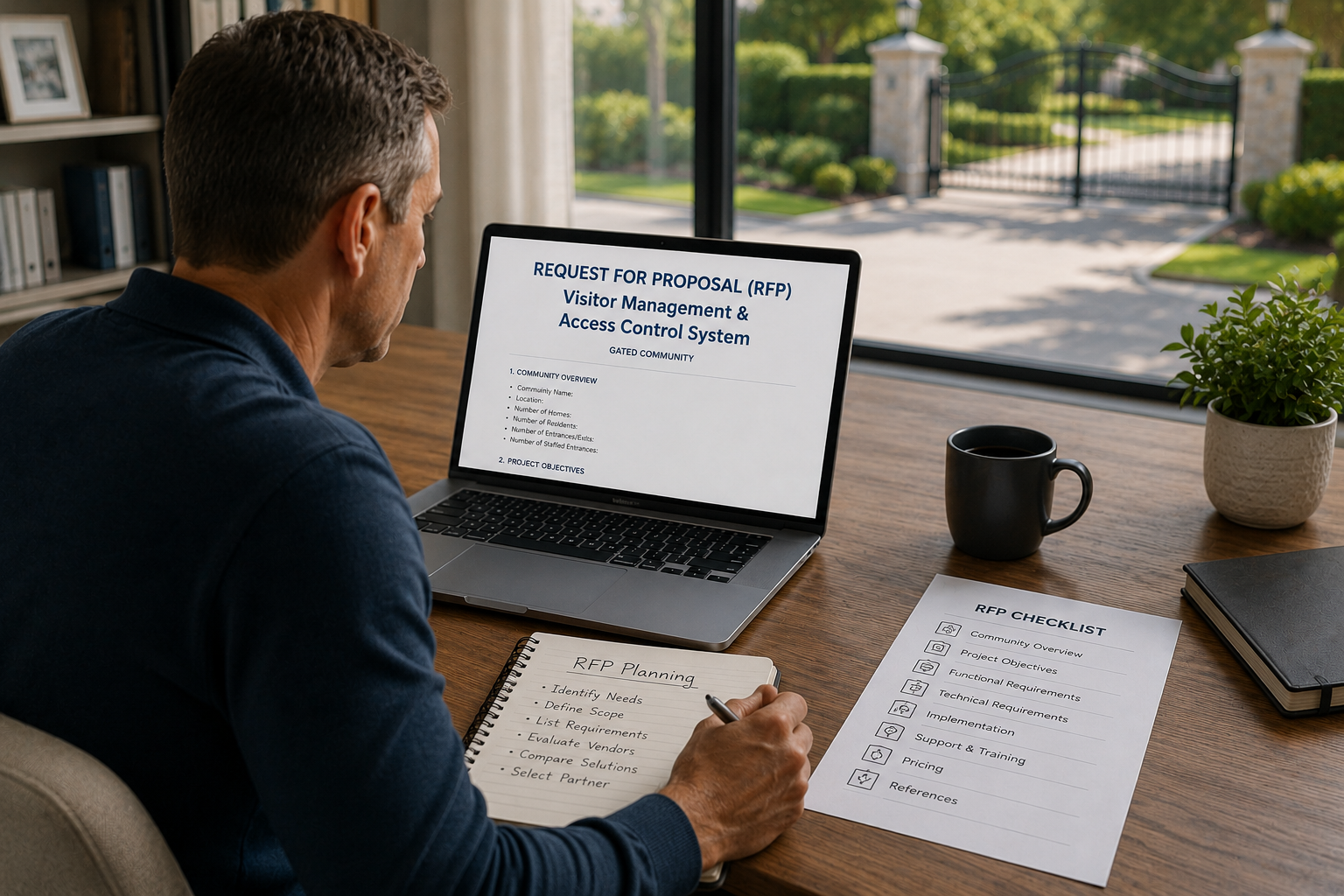
This downloadable RFP template gives HOA boards and property managers a ready-to-use framework for evaluating visitor management, access control, LPR, gate technology, integrations, implementation, and ongoing support. It includes community planning worksheets, vendor requirements, standardized pricing and five-year cost comparisons, demonstration criteria, and an evaluation scorecard so communities can compare proposals objectively without prematurely locking themselves into a specific technology or vendor.
Why HOAs Are Using RFPs for Visitor Management and Access Control
Replacing a visitor management or access control system can affect almost every part of a gated community.
Residents may use credentials or license plates to enter. Guests may interact with attendants, kiosks, mobile apps, or intercoms. Vendors may need temporary access. Property management needs reporting and administrative controls. Boards need to understand costs, security, implementation, and long-term support.
An RFP can bring structure to that buying process.
But the quality of the responses depends heavily on the quality of the RFP.
A generic security RFP may contain pages of requirements that have little relevance to visitor management. An IT-focused RFP may emphasize technical specifications while barely addressing how guests actually enter the community.
The better approach is to build the RFP around how the community operates.
Start With the Community, Not the Technology
Before asking vendors about features, document the environment the system needs to support.
At minimum, provide:
- Approximate number of homes or units
- Number of residents
- Number of entrances and exits
- Which entrances are staffed
- Guardhouse operating hours
- Resident-only entrances
- Current access methods
- Existing gate equipment
- Current visitor management system
- Approximate visitor and vendor volume
- Property management system, if applicable
- Known integrations
- Major problems with the current system
- Desired implementation timeline
This context can eliminate dozens of unnecessary questions later.
For example, a 600-home community with one staffed entrance has very different requirements from a 4,000-home community operating seven gates with attendants, resident-only entrances, license plate recognition, and multiple credential types.
Define the Problems the HOA Is Trying to Solve
An RFP should explain why the HOA is considering a change.
That could include:
- Long visitor processing times
- Too much manual guardhouse work
- Poor resident experience
- Limited reporting
- Expensive RFID or barcode credentials
- Difficulty managing vendors
- Inaccurate resident databases
- Limited integration with property management software
- Outdated access control hardware
- Lack of license plate recognition
- Difficulty managing unmanned entrances
- High staffing costs
- Limited visibility into gate activity
This gives respondents something far more useful than a predetermined feature checklist.
Instead of requiring a specific technology because the existing system uses it, describe the outcome the community needs.
For example:
Less useful: “System must support windshield RFID tags.”
Better: “Residents must have a reliable method of entering resident gates without guard intervention. Respondents should describe supported credential options, associated costs, and advantages or limitations of each.”
The second requirement allows the HOA to compare RFID, mobile credentials, license plate recognition, or other appropriate technologies.
Understand Who May Respond to the RFP
One of the most important parts of an access control RFP is understanding the different companies involved in delivering the system.
An HOA may encounter four types of providers:
Security Systems Integrators
Systems integrators design, install, configure, and support multiple components of a security system. They may provide access control, cameras, intercoms, LPR, gate integrations, networking, and visitor management technologies from several manufacturers.
Low-Voltage Contractors
Low-voltage companies typically handle physical infrastructure such as cabling, readers, controllers, networking, cameras, intercoms, and other electronic security equipment. Some also operate as full systems integrators.
Gate Companies
Gate contractors specialize in gates, operators, loops, safety devices, access equipment, and related physical infrastructure. Depending on the project, a gate company may work alongside an access control integrator or software provider.
Software Companies
Software providers develop visitor management, access control, resident management, LPR, or related platforms.
But there is an important distinction.
Not every software company sells directly to the HOA.
Many security technology companies use a dealer or systems integration model. The software company provides the technology while an authorized integrator or dealer sells, installs, configures, and potentially supports the complete system.
That means an HOA should not assume every requirement in the RFP applies equally to every respondent.
Separate Solution Requirements From Contractor Requirements
This is where many gated community RFPs become unnecessarily complicated.
Questions about cybersecurity, visitor workflows, integrations, reporting, mobile applications, or data ownership may appropriately be answered by the software provider.
Questions about contractor licensing, insurance, installation labor, cabling, permitting, gate modifications, and jobsite procedures may need to be answered by the integrator or installation contractor.
An RFP should therefore distinguish between:
Solution requirements, which evaluate what the technology does.
Implementation requirements, which evaluate how the system will be deployed.
Contractor requirements, which evaluate the company performing physical work at the property.
A proposal may involve more than one company. Allow respondents to clearly identify those parties and explain their responsibilities.
What Should Be Included in a Gated Community Visitor Management RFP?
The functional portion should focus on real community workflows.
Resident Management
Ask how residents are added, updated, and removed.
Determine whether the platform can integrate with the HOA’s property management system or other system of record so management does not have to maintain multiple resident databases manually.
Visitor Registration
Ask how residents can register guests and what options are available.
Depending on the community, this could include:
- Resident mobile applications
- Web portals
- Recurring guest lists
- Email invitations
- QR codes or digital passes
- Telephone or voicemail registration
- Guard-assisted registration
The RFP should describe the desired workflow rather than assuming one method.
Gatehouse Operations
For staffed entrances, determine how attendants find visitors, verify authorization, record arrivals, deny access, manage exceptions, and communicate with residents.
Ask what happens during internet or system outages.
Vendor and Contractor Access
Commercial visitors often require different rules from personal guests.
Ask whether the system can manage vendor schedules, recurring access, time restrictions, credentials, documentation, and reporting.
Resident Access Control
Ask respondents to describe available resident entry methods.
These could include RFID, mobile credentials, BLE, cards, fobs, PINs, LPR, or combinations of technologies.
Avoid requiring a specific credential unless there is a legitimate operational reason for doing so.
License Plate Recognition
If LPR is being considered, define the desired use case.
For example:
- Resident access
- Visitor verification
- Entry and exit logging
- Vehicle search
- Watchlists
- Investigations
- Overstay reporting
These are different requirements and may involve different system designs.
Reporting and Audit History
Ask what information management can retrieve after an event.
Important areas may include visitor history, vehicle activity, denied entries, vendor activity, credential usage, gate activity, administrator actions, and searchable audit trails.
Integrations
Identify existing systems that should remain part of the environment.
These may include:
- Property management software
- Access control
- Gate operators
- LPR cameras
- Video management systems
- Intercoms
- Resident applications
- Accounting or membership systems
Ask whether integrations are native, API-based, file-based, or custom.
Ask Respondents to Explain Their Delivery Model
Every proposal should clearly identify:
- Who provides the software?
- Who provides the hardware?
- Who performs installation?
- Who configures the system?
- Who provides ongoing support?
- Who provides resident or management training?
- Who handles hardware service calls?
- Who is responsible for integrations?
This makes very different proposals easier to compare.
It also prevents an HOA from eliminating a strong technology platform simply because the software manufacturer itself does not hold the contractor license or installation insurance required of the company performing the physical work.
How Should an HOA Compare RFP Responses?
Avoid making price the only measurable criterion.
A practical evaluation might consider:
- Functional fit
- Resident experience
- Management experience
- Security capabilities
- Integration capabilities
- Implementation approach
- Hardware flexibility
- Reporting
- Support model
- Vendor and installer qualifications
- References
- Initial project cost
- Recurring cost
- Five-year total cost of ownership
The weighting should reflect the community’s priorities.
If resident experience is one of the primary reasons for replacing the existing system, it should carry meaningful weight in the evaluation.
Common HOA RFP Mistakes to Avoid
Making the RFP Too Long
More questions do not necessarily produce better proposals. Irrelevant requirements create administrative work for both the HOA and respondents without improving the decision.
Copying a Generic Security RFP
Requirements designed for government facilities, enterprise IT departments, or commercial construction projects may have little relevance to a residential gated community.
Prescribing the Solution Too Early
If the RFP specifies exactly which credential, reader, database architecture, or visitor workflow must be used, the HOA may simply recreate its existing system with newer equipment.
Define the problem first and allow qualified respondents to propose solutions.
Treating the Software Provider and Installer as the Same Company
Security systems frequently involve manufacturers, software providers, integrators, gate companies, and other contractors.
Evaluate each party based on the role it will actually perform.
Asking for Pricing Without Enough Site Information
Respondents cannot accurately price gate hardware, cabling, readers, controllers, cameras, or installation without understanding the existing environment.
For larger projects, allow or require a site walkthrough before final pricing.
Comparing Only the Monthly Software Fee
Credential costs, hardware replacement, installation, support, maintenance, integrations, licensing, and future expansion can materially affect the total cost.
Compare total cost of ownership, not just one line item.
Should an HOA Require a Site Walk?
For projects involving physical access control infrastructure, a site walk is often valuable before final proposals are submitted.
It gives potential providers an opportunity to inspect existing gates, readers, controllers, guardhouses, network connectivity, vehicle lanes, cameras, intercoms, and other infrastructure.
The HOA also benefits because respondents can identify conditions that may not be obvious from the written RFP.
For software-only replacements, a detailed discovery session may be sufficient.
What Happens After the RFP?
The RFP should narrow the field, not automatically make the final decision.
After reviewing written responses, invite a small number of finalists to demonstrate their proposed solution using the HOA’s actual workflows.
Ask finalists to show how a resident registers a guest, how an attendant processes that guest, how management investigates an incident, how resident records are updated, and how the system handles exceptions.
That is usually more revealing than another 100 questions in a spreadsheet.
Entity Snapshot
- HOA: Homeowners association responsible for managing a residential community and its common operations.
- Visitor management system: Software used to register, authorize, track, and manage guests and vendors.
- Access control: Technology that determines who or what can enter controlled areas.
- Systems integrator: Company that designs, installs, connects, and supports multiple security technologies.
- Low-voltage contractor: Company that installs cabling and electronic security infrastructure.
- Gate company: Contractor specializing in vehicle gates, operators, safety equipment, and related infrastructure.
- LPR: License plate recognition technology that identifies and records vehicle license plates.
- Property management system: Software used to maintain homeowner, resident, property, and community records.
Frequently Asked Questions
What should an HOA include in a visitor management RFP?
Include community information, existing systems, operational problems, visitor workflows, resident access requirements, integrations, implementation expectations, support requirements, and a standardized pricing format.
How long should an HOA access control RFP be?
It should be long enough to define the community’s requirements without adding irrelevant boilerplate. A focused RFP that clearly describes operations is generally more useful than a lengthy generic security questionnaire.
Should an HOA send the RFP to software companies or security integrators?
Potentially both. Some software companies sell directly, while others distribute through authorized security integrators or dealers that provide installation, hardware, and local support.
Should an HOA specify which access control technology vendors must use?
Only when there is a legitimate requirement. Otherwise, describe the desired outcome and ask respondents to recommend appropriate technologies and explain their advantages, limitations, and costs.
Does an HOA need a site walk before selecting an access control system?
A site walk is recommended when the project includes gates, readers, controllers, cameras, intercoms, cabling, networking, or other physical infrastructure that affects design and pricing.
How should an HOA compare visitor management proposals?
Compare functional fit, resident experience, integrations, implementation, support, installer qualifications, security capabilities, and total cost of ownership using the same evaluation criteria for each proposal.
Who should answer insurance and contractor licensing questions in an RFP?
The company performing the applicable installation or contracting work should provide those qualifications. In a dealer-based model, that may be the systems integrator or installer rather than the software manufacturer.