

Quick Answer
HOA’s in the growing city of Austin Texas are shifting from expensive guard-dependent entry to system-driven Virtual guarding. Most communities see faster entry, fewer errors, and lower staffing pressure by combining remote monitoring with automated gate technology.
Suggested Reads
Gate Guard Cost vs Virtual Guard Cost: Which Is Right For Your HOA?
Why HOAs Should Adopt Visitor Processing Kiosks Integrated With LPR for Seamless Check-Ins
The Real Decision HOAs Are Making
This is not about adding cameras or replacing guards. It is about deciding how your gates actually operate day to day.
Austin HOAs are choosing between people manually managing entry or systems enforcing access rules consistently. That choice affects wait times, staffing costs, and how secure the community actually is.
In many Austin neighborhoods, gatehouses handle a mix of residents, deliveries, and service providers from early morning through evening. Without system support, that volume becomes hard to manage consistently across shifts.
The Core Options Available to HOAs
Fully Guard-Based Entry
Guards verify every visitor, manage guest lists, and control gate access manually. This is common in older communities or those with established gatehouses.
Hybrid Guard + System Support
Guards remain on-site but rely on tools like license plate recognition, visitor management software for HOAs, and mobile credentials to speed up decisions.
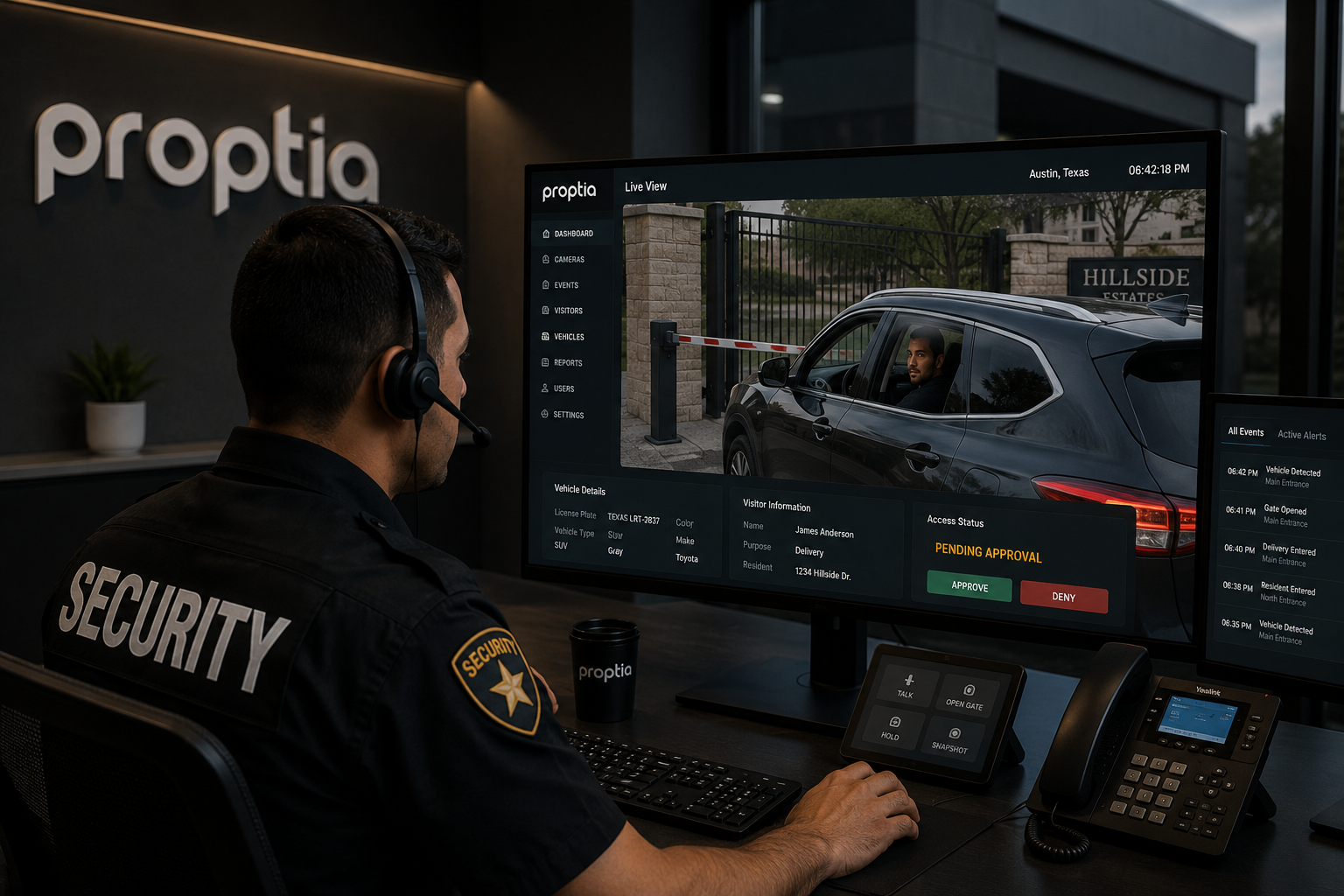
Virtual Guarding with Remote Oversight
On-site guards are reduced or removed. Remote operators monitor gates via cameras, manage exceptions, and communicate with visitors as needed.
Fully Automated Access
Residents and pre-approved visitors enter through LPR, mobile credentials, or PIN systems with minimal human involvement.
Each model changes how your HOA handles traffic, staffing, and daily operations.
Tradeoffs Between These Approaches
- Guard-based systems
High oversight, but inconsistent execution
Slower during peak hours
Labor-intensive and expensive - Hybrid systems
Better speed and consistency
Still reliant on guard performance
Moderate cost savings - Virtual guarding
Reduced staffing needs
Centralized control and monitoring
May require process changes for residents - Fully automated
Fastest entry times
Lowest ongoing labor cost
Less flexibility for unplanned access
The key difference is how much your system depends on human decision-making versus predefined rules.
What Actually Drives Performance at the Gate
Performance is not about how secure a system looks. It comes down to throughput and consistency.
- Vehicle processing speed
Peak entry windows in Austin often cluster around morning commutes and early evening returns. Systems that rely on manual verification struggle to keep up. - Accuracy of access decisions
Guards may interpret rules differently. A strong HOA access control setup applies rules the same way every time. - Handling of visitor volume
Delivery traffic in Austin continues to rise, especially in larger communities. Systems that pre-authorize visitors reduce friction significantly. - Dependency on staffing
When operations depend heavily on guards, performance varies by shift, training, and workload.
Communities with shared amenities like pools or clubhouses often see steady non-resident traffic throughout the day, which makes automation even more valuable for maintaining flow.
Where Most HOAs Get It Wrong
Many boards assume adding more guards will solve access issues. In reality, this often increases cost without fixing inconsistencies.
Another common mistake is underestimating how quickly traffic patterns evolve. A community that worked fine five years ago may now struggle with delivery volume and service access.
Some HOAs also overlook how fragmented systems create problems. Separate tools for gates, calls, and visitor logs lead to gaps in visibility and control.
Finally, focusing only on upfront cost often leads to solutions that create long-term operational friction.
Virtual Guarding in Austin HOAs
Virtual guarding Austin HOAs is gaining traction because it aligns with how these communities actually operate today.
Many Austin neighborhoods have multiple entrances spread across large properties. Coordinating staff across those points creates uneven enforcement and higher costs.
Virtual guarding centralizes oversight. A remote team monitors all entry points, supported by technologies like license plate recognition and vehicle alert systems that flag exceptions in real time.
This approach works especially well in communities where:
- Entry points are distributed rather than centralized
- Delivery and vendor traffic is consistent throughout the day
- Staffing reliable on-site coverage is difficult or expensive
Instead of reacting to every vehicle manually, the system handles routine access while operators focus only on exceptions.
How to Evaluate Systems for Your Community
Start with your actual usage patterns, not assumptions.
- How many vehicles enter during peak hours
- How many gates you operate
- The ratio of residents to visitors
- Frequency of vendor and delivery access
- Whether rules are enforced consistently today
If your gates regularly back up, your issue is likely throughput, not security policy.
If your guards spend most of their time repeating the same approvals, that is a strong indicator automation can improve efficiency.
Also consider how well your current system connects. Platforms that unify visitor management software for HOAs with access control and monitoring tools tend to perform more reliably.
Cost vs Operational Impact
The cost conversation often misses the bigger picture.
Guard-heavy models come with:
- Salaries and benefits
- Overtime and turnover
- Training and management overhead
System-driven models shift cost toward technology but reduce ongoing labor dependency.
More importantly, operational impact shows up in:
- Reduced wait times at gates
- Fewer access errors
- Higher resident satisfaction
- Better visibility into entry activity
A lower-cost system that slows down traffic or creates frustration can become more expensive over time than a higher upfront investment.
Integration and Upgrade Considerations
Most Austin HOAs do not need to replace everything at once.
Modern platforms can layer onto existing infrastructure, including gates, cameras, and entry devices. This allows phased upgrades rather than full replacements.
For example, a community might start by adding license plate recognition and remote monitoring, then later expand into mobile credentials or centralized access control.
Solutions like Proptia are designed to integrate with existing systems, giving HOAs the ability to modernize without disrupting operations.
The key is choosing a platform that supports both current needs and future expansion.
Conclusion
Virtual guarding is not just a technology shift. It is an operational decision about how your community manages access every day.
Austin HOAs are dealing with growing traffic, more service providers, and higher expectations from residents. Systems that rely less on manual processes are better positioned to keep up.
The right approach depends on your gates, your traffic, and your tolerance for staffing complexity. Focus on how your system performs under real conditions, not how it looks on paper.
If your current setup struggles with consistency or volume, it may be time to rethink how your gates are managed.
Suggested Reads
Gate Guard Cost vs Virtual Guard Cost: Which Is Right For Your HOA?
Why HOAs Should Adopt Visitor Processing Kiosks Integrated With LPR for Seamless Check-Ins
FREQUENTLY ASKED QUESTIONS
What is virtual guarding for HOAs?
Will we still need on-site guards?
Is it more cost-effective than traditional guards?
What happens if the system fails?
Good systems include redundancies and manual override options to ensure continued access when needed.
Is virtual guarding reliable during high traffic times?
How does it handle visitor access?
Visitors are pre-approved through systems, and exceptions are handled by remote operators in real time.