

Quick Answer
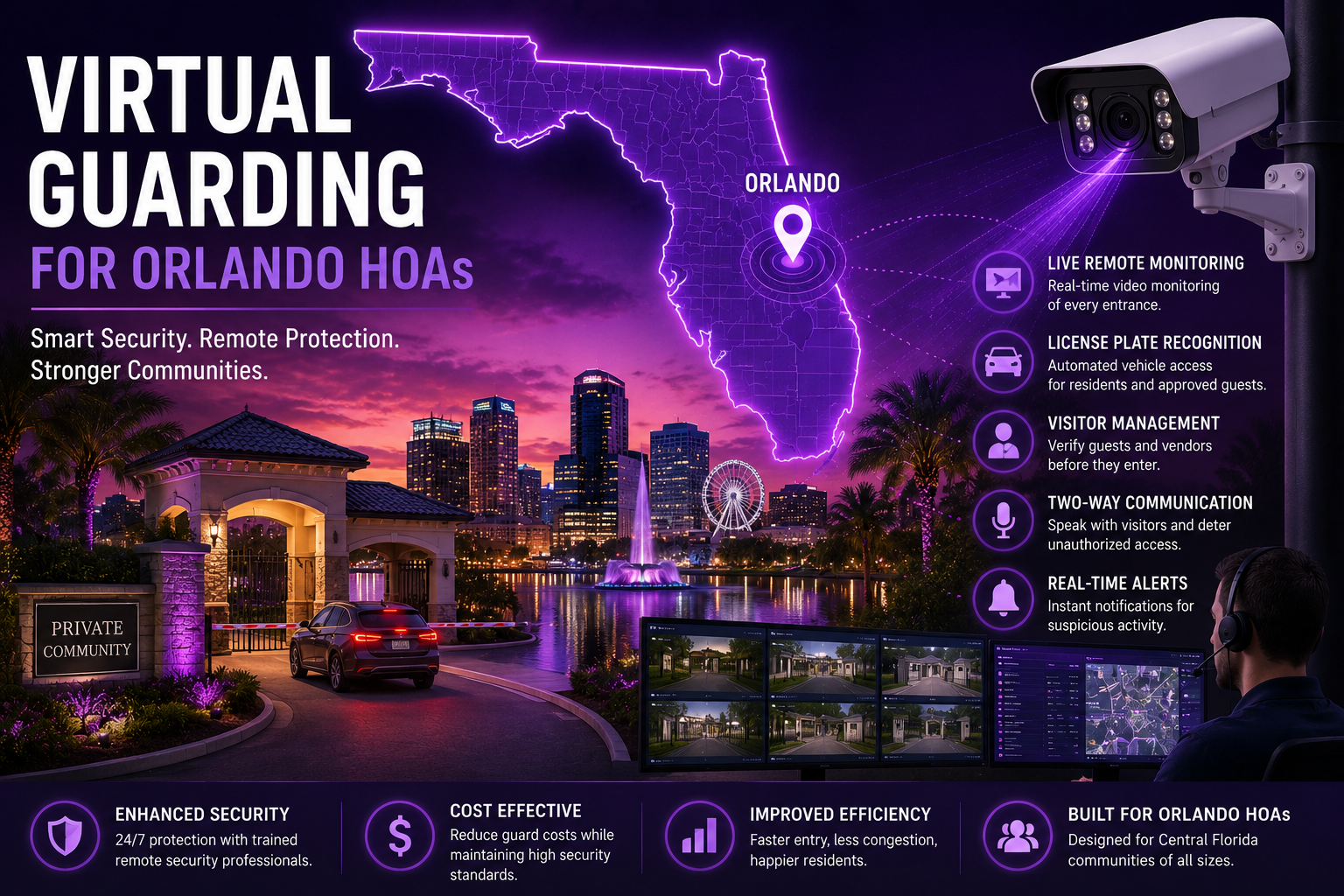
Virtual guarding Orlando HOAs use is a security approach where cameras, remote monitoring, and automated access systems replace or support on-site guards. In a city like Orlando, where many communities see frequent visitors, deliveries, and seasonal residents, virtual guarding helps maintain consistent control without increasing staffing costs. It allows HOAs to monitor entry points, verify visitors, and respond to incidents in real time.
Virtual Guarding Orlando HOAs: What You Need to Know
Orlando HOAs face a unique mix of challenges. There is steady population growth, a high volume of short-term visitors, and many communities with multiple entry points. Traditional guardhouses staffed around the clock can be expensive and inconsistent.
Virtual guarding offers a different approach. Instead of relying fully on in-person staff, communities use remote operators, cameras, and integrated access control systems to manage entry and monitor activity.
This does not mean removing all physical presence. Many HOAs use a hybrid model where peak hours are staffed, and off-hours are handled virtually. Others transition fully to remote operations when budgets or staffing shortages make full-time guards impractical.
The key shift is this: security decisions are supported by technology rather than dependent on a single person at a gate.
How Virtual Guarding Works in Orlando Communities
At a practical level, virtual guarding connects several systems into one workflow.
When a vehicle or visitor arrives at a gate, cameras and sensors capture information immediately. A remote operator or automated system verifies access based on pre-approved lists, credentials, or live communication.
For example, a resident may use mobile credentials or a keypad entry. A guest might be pre-registered through a visitor management system. Delivery drivers can be verified through video and granted temporary access.
License plate recognition for gated communities plays a major role here. Vehicles can be identified automatically, reducing wait times and limiting the need for manual checks.
If something unusual happens, such as a flagged vehicle or a person on a watchlist, alerts are triggered instantly. This is where tools like person of interest alerts or BOLO detection systems come into play. They help communities identify risks before they escalate.
All of this is monitored in real time, often from a centralized operations center that can oversee multiple properties at once.
Why It Matters for HOAs
For many Orlando HOAs, the biggest pressure points are cost, consistency, and visibility.
Staffing a gatehouse 24 hours a day is expensive. Turnover can be high, and training varies. Virtual guarding reduces reliance on staffing while improving consistency. Systems do not forget procedures or skip steps.
There is also the issue of coverage. A single guard cannot see everything. Cameras and remote monitoring provide a wider view of the property, including entrances, exits, and common areas.
Another important factor is response time. With virtual guarding, alerts can be triggered instantly and handled by trained operators who are focused solely on monitoring. They are not distracted by administrative tasks or face-to-face interactions.
Finally, documentation improves. Every entry, denial, and incident is logged automatically. This helps HOA boards and property managers review activity, resolve disputes, and improve policies over time.
Key Features to Look For
Not all virtual guarding setups are equal. The effectiveness comes down to how well the system is designed and integrated.
Look for solutions that include real-time video monitoring with two-way communication. This allows operators to interact with visitors and residents when needed, rather than relying only on automation.
Strong hoa access control is essential. The system should support multiple entry methods, including mobile credentials, keypads, and remote approvals.
License plate recognition should be accurate and fast. In busy Orlando communities, delays at the gate can quickly lead to backups and frustration.
Visitor management is another critical piece. Pre-registration, temporary passes, and delivery handling should be simple for residents and easy to enforce at entry points.
Alerting capabilities matter as well. Systems that support person of interest alerts or BOLO detection systems provide an extra layer of awareness, especially in larger communities.
Finally, look for centralized control. Property managers should be able to view activity, update permissions, and generate reports from a single dashboard.
Platforms like Proptia bring these features together, allowing HOAs to manage gates, visitors, and monitoring in one system without replacing everything at once.
Common Mistakes to Avoid
One common mistake is assuming virtual guarding is just cameras. Cameras alone do not provide security unless someone is actively monitoring and responding.
Another issue is poor system integration. When access control, visitor management, and surveillance operate separately, gaps appear. Visitors get delayed, residents get frustrated, and staff have to manage multiple systems.
Some HOAs also underestimate the importance of resident communication. Changes to entry procedures can cause confusion if not explained clearly. Residents need to understand how to use new tools like mobile access or pre-registration.
Over-automation is another risk. Not every situation should be handled without human involvement. A balanced approach that combines automation with live monitoring works best.
Lastly, choosing systems based only on cost can lead to higher expenses later. Reliability, support, and ease of use are just as important as upfront pricing.
How It Integrates With Existing Systems
Most Orlando HOAs already have some level of security infrastructure in place. Virtual guarding does not require starting from scratch.
Existing gates, cameras, and access control systems can often be integrated into a modern platform. This allows communities to upgrade gradually rather than replacing everything at once.
For example, a community might keep its current gate hardware but add license plate recognition and remote monitoring. Another might upgrade visitor management while maintaining existing access credentials.
Telephone entry systems can also be modernized, allowing residents to grant access from their smartphones instead of relying on outdated call boxes.
The goal is to unify these systems so they work together. When a vehicle approaches, the camera reads the plate, the access control system checks permissions, and the monitoring team oversees the process.
Proptia is one example of a platform that supports this modular approach. HOAs can replace one component or adopt a full system depending on their needs.
Key Terms Explained
– Virtual guarding: A security approach that uses remote monitoring and automated systems instead of on-site guards
– Access control: A system that determines who can enter a property and when
– License plate recognition: Technology that identifies vehicles by reading their license plates automatically
– Visitor management: Tools that track and manage guests, vendors, and deliveries دخول and exit
– Person of interest alerts: Notifications triggered when a flagged individual or vehicle is detected
– BOLO detection systems: Systems that identify “be on the lookout” vehicles or individuals based on stored data
– Remote monitoring: Live observation of a property by off-site security operators
Suggested Internal Links
access control
license plate recognition
bolo detection
poi alerts
FREQUENTLY ASKED QUESTIONS
Is virtual guarding reliable for large Orlando communities
How does it handle visitors and deliveries
Is it difficult for residents to use?
Is virtual guarding more cost-effective?
Can virtual guarding replace gate guards completely?
What happens if there is a security incident?
Does it work with older gate systems?
Get in Touch
Interested in how virtual guarding can optimize your security operations?
Schedule a Demo Now!