

Quick Answer
Remote guarding for HOAs is gaining traction because many communities can reduce security labor costs while maintaining or improving gate operations. As security staffing becomes more expensive and harder to maintain, HOA boards are increasingly evaluating remote and hybrid guarding models as long-term alternatives to traditional gatehouse staffing.
The Real Decision HOAs Are Making
The conversation is often framed as guards versus technology.
That is not the real decision.
The real decision is whether a community wants to continue relying primarily on labor to manage security operations or shift toward a system-driven model that uses technology to reduce staffing requirements while maintaining security standards.
Many gated communities are facing rising labor costs, increased turnover, staffing shortages, and pressure to control operating budgets. At the same time, residents still expect a secure, professional entry experience.
As a result, boards and property managers are asking a different question:
How much of our gate operation truly requires a person physically sitting in a gatehouse?
That question is driving interest in remote guarding, virtual guarding, visitor kiosks, license plate recognition, access control systems, and centralized monitoring.
The Core Options Available to HOAs
Most communities evaluating security operations fall into one of four categories.
Traditional On-Site Guarding
This is the model most residents recognize.
Guards physically staff the gatehouse, verify visitors, answer resident calls, monitor cameras, and control entry points.
The advantage is a visible security presence.
The challenge is cost, scheduling, turnover, training, and maintaining consistent performance across multiple shifts.
Hybrid Guarding
Hybrid models combine on-site guards with remote operators and automation.
For example:
- Guards may staff gates during peak traffic periods
- Remote operators may manage overnight operations
- Cameras and LPR systems may automate resident entry
- Visitor kiosks may reduce manual processing
This approach often delivers a balance between cost savings and resident expectations.
Remote Guarding
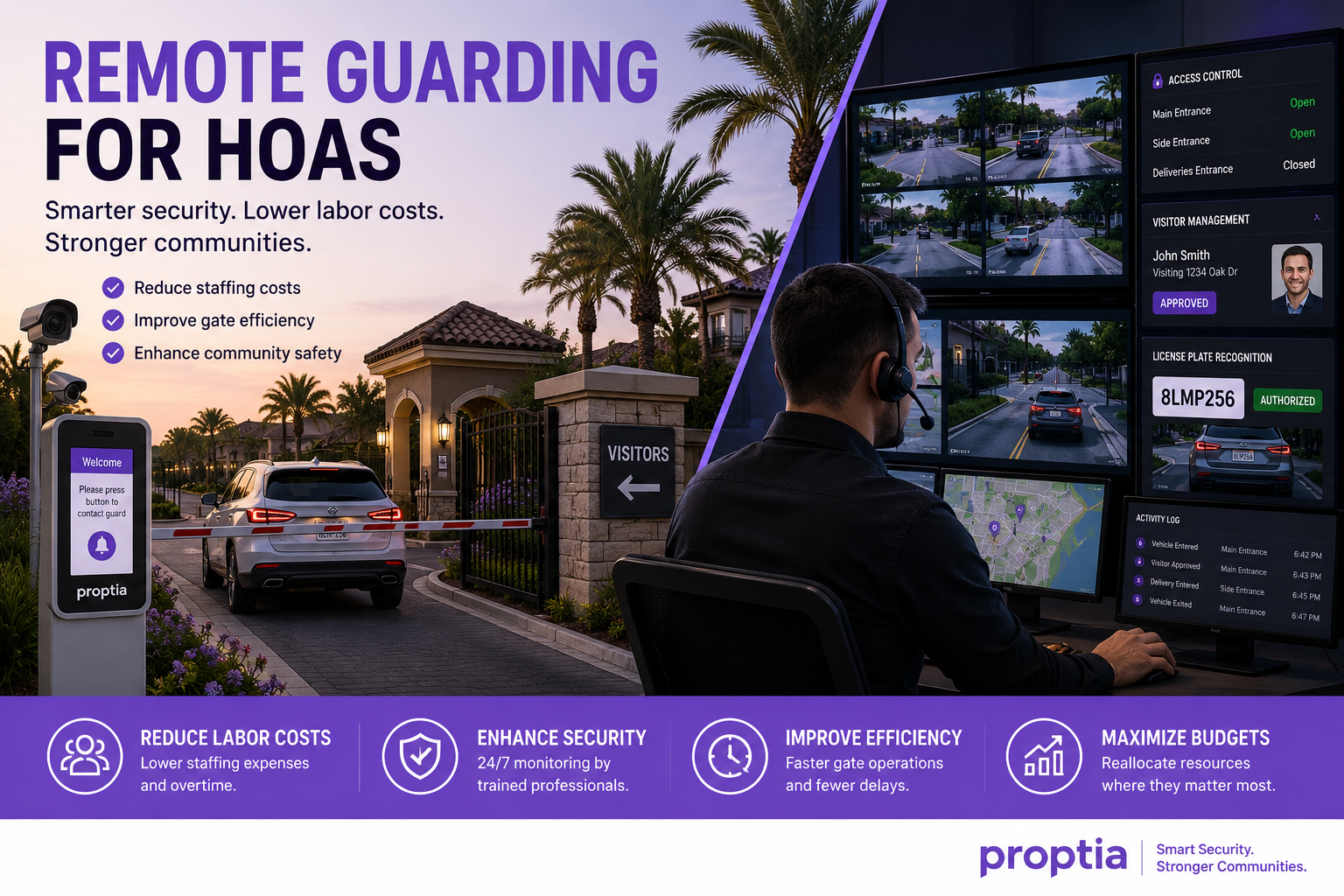
Remote guards monitor and manage gate operations from a centralized command center.
Operators can:
- Review surveillance cameras
- Process visitors
- Open gates remotely
- Monitor alarms
- Review access events
- Respond to incidents
Residents still receive security oversight, but the community no longer carries the full cost of on-site staffing.
Fully Automated Entry Systems
Some communities automate most gate activity.
Residents enter through RFID, Bluetooth credentials, transponders, mobile credentials, or license plate recognition.
Visitors are processed through visitor management systems and self-service kiosks.
Human intervention occurs only when exceptions arise.
Tradeoffs Between These Approaches
Every security model involves tradeoffs.
Traditional Guarding
- Highest labor costs
- Strong physical presence
- Greater staffing risk
- Higher turnover exposure
- Performance varies by individual guard
Hybrid Guarding
- Moderate labor costs
- Maintains visible security presence
- Flexible staffing model
- Easier transition from legacy operations
- Balances automation with human oversight
Remote Guarding
- Lower labor costs
- Centralized monitoring
- Consistent operating procedures
- Reduced staffing challenges
- Less visible security presence
Fully Automated Systems
- Lowest staffing dependency
- Fast resident throughput
- Highly scalable
- Requires strong technology infrastructure
- May not fit every community culture
The right answer depends less on technology and more on how the community operates.
What Actually Drives Performance at the Gate
Many communities focus on security features.
Residents experience outcomes.
The metrics that matter most include:
Vehicle Throughput
How quickly can vehicles enter during busy periods?
Long lines create frustration and often encourage guards to cut corners to keep traffic moving.
Verification Speed
How quickly can visitors be authorized and processed?
Slow verification creates backups and increases resident complaints.
Consistency
Does every shift follow the same procedures?
Technology-driven workflows often improve consistency because processes become standardized rather than dependent on individual guards.
Error Rates
How often are unauthorized visitors admitted?
How often are authorized visitors delayed?
Both outcomes create operational problems.
Scalability
Can the system handle holiday traffic, events, contractors, deliveries, and seasonal surges?
Many communities discover their staffing model works until traffic volume increases.
Where Most HOAs Get It Wrong
The biggest mistake is evaluating security solely based on monthly staffing costs.
A community may compare a guard contract to a remote guarding proposal and focus only on the monthly number.
That often misses the larger operational picture.
Another common mistake is assuming every gate transaction requires a guard.
Many resident entries can be automated through:
- License plate recognition
- RFID credentials
- Mobile credentials
- Bluetooth access
- Access control integrations
The guard’s attention can then be focused on exceptions rather than routine traffic.
Communities also frequently underestimate future labor costs.
Security wages rarely move downward.
Communities that build their security model entirely around staffing often find themselves facing larger budget increases every year.
Finally, some boards overestimate the effectiveness of physical presence alone.
A guard can only see what is directly in front of them.
A properly designed remote guarding environment may provide access to multiple cameras, recorded footage, alerts, visitor records, and license plate data simultaneously.
How to Evaluate Systems for Your Community
Before evaluating vendors, communities should first evaluate themselves.
Start with a few simple questions.
How Many Entrances Need Coverage?
One entrance creates different requirements than a community with multiple staffed gates.
What Is Your Daily Vehicle Volume?
Traffic volume significantly impacts staffing requirements and throughput expectations.
What Percentage of Traffic Is Residents Versus Visitors?
Communities with high resident traffic often benefit significantly from automation.
Do You Experience Staffing Challenges Today?
Frequent turnover, overtime, or guard shortages may indicate a need for operational changes.
What Are Resident Expectations?
Some communities place a high value on visible security personnel.
Others prioritize speed, convenience, and operational efficiency.
Are Cameras and Access Control Already Installed?
Existing infrastructure can often be leveraged rather than replaced.
This creates a more cost-effective transition path.
Cost vs Operational Impact
The cheapest security solution is not always the lowest-cost solution.
Labor represents one cost.
Operational friction creates another.
When evaluating options, communities should consider:
- Security staffing costs
- Overtime expenses
- Recruiting costs
- Training costs
- Turnover costs
- Traffic delays
- Resident complaints
- Gate processing speed
- Incident response capabilities
A community may save money on technology by avoiding upgrades today.
That decision may create significantly higher labor expenses over the next five years.
The opposite can also be true.
Investments in automation, remote guarding, visitor management, and access control often reduce recurring operating costs while improving consistency.
Integration and Upgrade Considerations
One misconception is that adopting remote guarding requires replacing everything.
In many cases, communities can implement remote guarding in phases.
Existing infrastructure can often remain in place, including:
- Gate operators
- Access control hardware
- Surveillance cameras
- Intercom systems
- Visitor lanes
- Resident credentials
Many communities begin by adding remote monitoring to existing operations.
Others replace overnight staffing before expanding further.
Some deploy visitor kiosks, license plate recognition, or visitor management systems first and transition to remote guarding later.
The goal should not be replacing technology.
The goal should be improving operations.
Modern platforms like Proptia allow communities to enhance or replace portions of their security infrastructure while maintaining flexibility to integrate with existing systems and hardware investments.
Conclusion
The shift toward remote guarding is not simply about reducing labor costs. It is about building a security operation that can scale as staffing becomes more expensive and more difficult to maintain.
For many gated communities, the future is not fully manual or fully automated. It is a thoughtful combination of people, processes, and technology designed around operational efficiency.
The communities seeing the greatest success are evaluating how work gets done at the gate, not simply who is sitting in the gatehouse. That perspective often leads to smarter long-term decisions and a clearer path toward modern security operations.
FAQ Section
What is remote guarding for HOAs?
Remote guarding allows trained operators to monitor and manage security functions from a centralized location rather than being physically stationed at the community.
Is remote guarding cheaper than traditional guards?
In many cases, yes. Communities often reduce labor, overtime, recruiting, and turnover costs while maintaining security oversight.
Can remote guards process visitors?
Yes. Remote operators can review visitor information, communicate through intercoms or kiosks, verify authorization, and grant access when appropriate.
Do remote guards monitor surveillance cameras?
Yes. Monitoring cameras is one of the primary functions of a remote guarding operation.
Can remote guarding work alongside on-site guards?
Yes. Many communities use hybrid models where on-site guards and remote operators work together.
What happens if internet service goes down?
Most professionally designed systems include local hardware, backup procedures, and failover processes to maintain operations during outages.
Does remote guarding replace license plate recognition?
No. License plate recognition and remote guarding often work together to improve vehicle verification and gate efficiency.
Are residents comfortable with virtual guards?
Many residents do not notice a difference when visitor processing, communication, and gate operations remain smooth and consistent.
Is remote guarding only for large communities?
No. Both small and large communities can benefit depending on traffic volume, staffing costs, and operational goals.
Can a community transition gradually?
Yes. Many communities start with overnight monitoring, secondary entrances, or camera monitoring before expanding remote guarding programs.