

Quick Answer
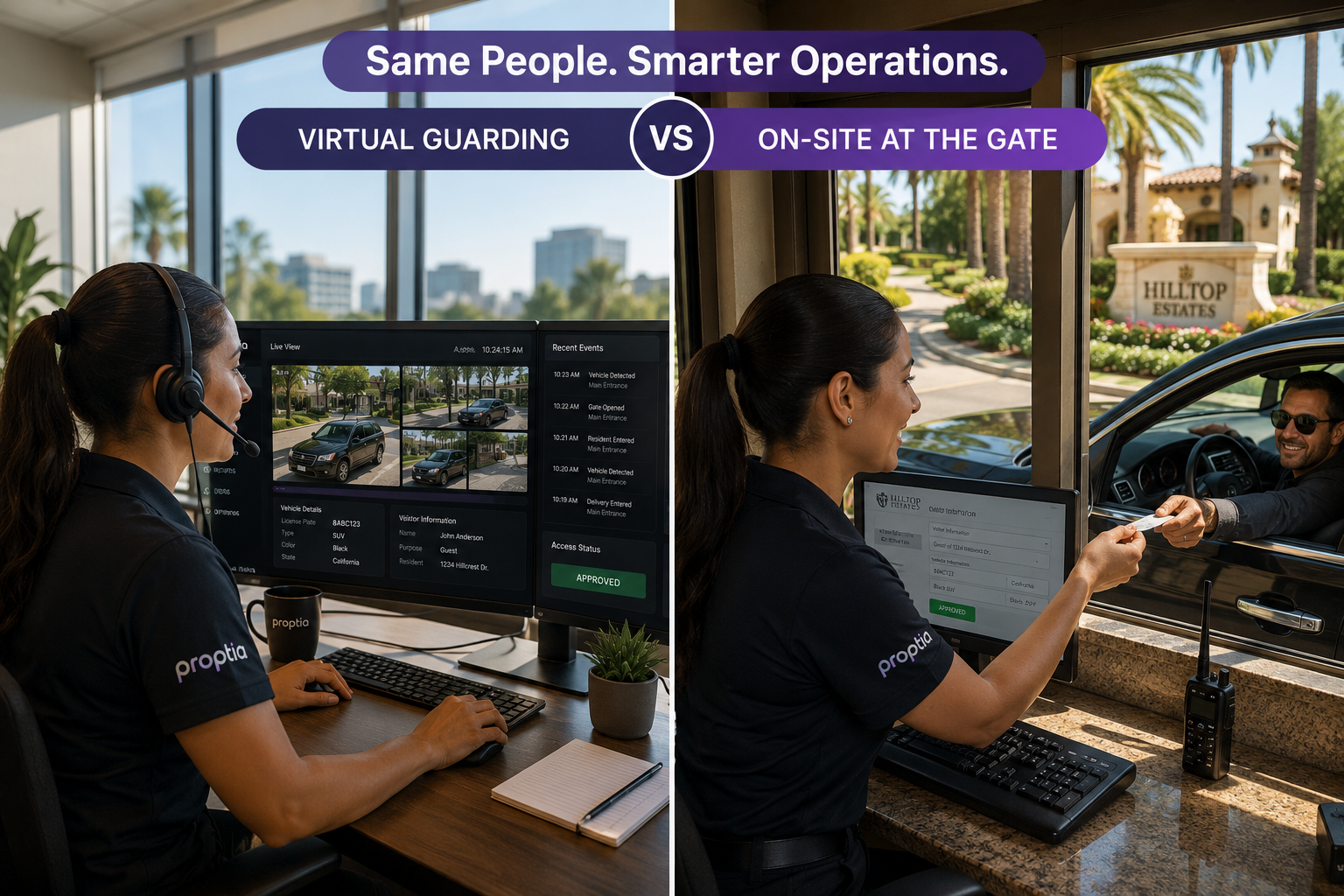
Virtual guarding for California HOAs combines remote security operators, cameras, access control, and visitor management into a centralized entry workflow. For many gated communities, it reduces staffing pressure, improves gate consistency, and increases visibility into who is entering the property without requiring a full replacement of existing infrastructure.
The Real Decision HOAs Are Making
Most California HOAs are not deciding between “guards or no guards.” They are deciding how dependent they want to be on manual gate operations.
That distinction matters. A community with multiple entrances, vendor traffic, clubhouse activity, and steady deliveries can quickly overwhelm a fully manual process. Even strong guard teams struggle when every decision relies on human verification during peak hours.
The real question becomes:
How much of the community’s access operation should depend on staffing versus systems?
Some California HOAs still prefer fully staffed gates because residents value a visible security presence. Others prioritize consistency, throughput, and operational efficiency.
Virtual guarding sits between those priorities. It allows communities to centralize oversight while reducing many of the operational bottlenecks tied to traditional guard-only models.
The Core Options Available to HOAs
California HOAs generally fall into one of three operational models.
Traditional Guard-Based Entry
This is the most manual approach.
Guards verify visitors, manage resident access, answer calls, and monitor activity directly from the gatehouse. Some communities still rely heavily on paper logs or disconnected systems.
This model works best in smaller communities with limited traffic volume and fewer entry points.
Hybrid Guard and Virtual Guarding Systems
This is becoming one of the most common approaches in larger California communities.
On-site guards remain present during peak hours, while remote operators and automated systems support verification, after-hours monitoring, and visitor processing.
This approach balances human interaction with operational consistency.
Fully Virtual Guarding Operations
In this model, remote operators manage entry activity using cameras, kiosks, access control systems, and live monitoring tools.
Visitors interact through call boxes, visitor kiosks, or mobile-based workflows while remote agents verify access and open gates when approved.
This approach is often used in communities focused on reducing labor dependency while maintaining oversight.
Get in Touch
Interested in learning how Proptia gives California HOAs flexibility in balancing security coverage, operational efficiency, and staffing costs?
Schedule a Demo Now!
Tradeoffs Between These Approaches
Each model solves different problems.
Traditional Guard Operations
- Higher human presence
- More flexible judgment calls
- Higher staffing costs
- Greater inconsistency between shifts
- Slower entry during peak traffic
Hybrid Systems
- Better traffic handling
- Reduced guard workload
- More operational consistency
- Easier phased adoption
- Still requires some staffing coordination
Fully Virtual Guarding
- Lower long-term labor dependency
- Standardized workflows
- Faster centralized oversight
- Strong audit trails and reporting
- Less physical on-site presence
The best system is rarely the most automated one. It is the one that matches the operational complexity of the community.
A smaller gated HOA with one entrance operates very differently than a large California master-planned community with multiple gates, amenities, vendors, and delivery traffic moving all day long.
What Actually Drives Performance at the Gate
Most HOA boards focus heavily on hardware.
In reality, gate performance usually comes down to workflow efficiency.
Several factors determine whether entry operations run smoothly:
Vehicle Throughput
How many vehicles can enter during busy periods without backups forming?
Communities near commuter corridors often experience concentrated traffic spikes in the mornings and evenings. Manual verification alone can create significant congestion during these windows.
Verification Speed
How quickly can visitors, vendors, and deliveries be approved?
Systems that require guards to manually search resident directories or call homeowners repeatedly tend to slow operations dramatically.
Consistency of Enforcement
Rules matter less if they are applied differently every shift.
Properties that rely heavily on guard discretion often experience resident complaints about inconsistent treatment or unclear entry procedures.
Visibility and Audit Trails
Most HOAs want more than security. They want accountability.
Modern virtual guarding systems create detailed logs showing:
- Visitor activity
- Gate access events
- Vehicle history
- License plate records
- Entry timestamps
- Operator actions
That visibility becomes important when investigating incidents or resolving disputes.
Integration Between Systems
Disconnected systems create operational drag.
If visitor management, license plate recognition, telephone entry, and access control all operate independently, staff spend more time navigating systems than managing traffic flow.
Platforms like Proptia help centralize these workflows into a single operational environment while allowing communities to keep portions of their existing infrastructure in place.
Where Most HOAs Get It Wrong
Many California HOAs approach virtual guarding as a staffing replacement decision only.
That usually leads to poor outcomes.
The communities that succeed tend to focus on operational flow first.
Several mistakes appear repeatedly:
Optimizing Only for Upfront Cost
The cheapest system is often the one residents complain about most later.
Slow entry, confusing workflows, poor verification, and inconsistent support create operational friction that eventually becomes a management problem.
Overestimating Manual Guard Capacity
A single guard can only process so many vehicles effectively during peak periods.
As delivery traffic and vendor activity continue increasing across California communities, manual processes become harder to sustain at scale.
Ignoring Community Layout Complexity
Communities with separate resident lanes, guest lanes, clubhouse traffic, and service access points require different workflows than single-entry properties.
One-size-fits-all solutions usually create bottlenecks somewhere in the operation.
Underestimating Resident Expectations
Residents increasingly expect faster, app-based, self-service workflows.
Communities that continue relying entirely on phone calls and manual guest approvals often experience growing frustration around entry delays.
How to Evaluate Systems for Your Community
The right virtual guarding setup depends heavily on operational realities.
Before evaluating vendors or systems, HOAs should first evaluate themselves.
How Busy Are Your Entry Points?
A low-volume gated entrance has different requirements than a property processing hundreds of vehicles daily.
Traffic volume directly affects staffing needs, automation requirements, and lane configuration decisions.
How Many Entrances Exist?
Managing one gate is very different from managing five.
California communities with multiple entry points often struggle when access workflows are not centralized across all gates.
What Percentage of Traffic Is Non-Resident?
Communities with restaurants, golf courses, clubhouses, pools, or shared amenities tend to experience continuous guest traffic throughout the day.
That changes how visitor verification systems should operate.
How Dependent Are You on Guards Today?
Some communities already operate efficiently with strong guard teams.
Others rely heavily on guards to compensate for weak systems.
Understanding that distinction is critical before making operational changes.
Are Existing Systems Already in Place?
Many HOAs assume modernization requires replacing everything.
In practice, phased upgrades often work better.
A community may keep:
- Existing gates
- Existing cameras
- Existing access hardware
While upgrading:
- Visitor management
- Remote monitoring
- License plate recognition
- Mobile credentials
- Entry workflows
Cost vs Operational Impact
Most HOA discussions start with labor cost.
That makes sense, but labor is only part of the equation.
Operational inefficiency creates hidden costs everywhere else.
Delays Create Resident Friction
Residents remember waiting at gates.
They remember guests being denied incorrectly.
They remember inconsistent enforcement.
Those operational frustrations eventually become board complaints.
Manual Processes Consume Staff Time
Property managers often spend significant time resolving access issues caused by disconnected systems or outdated records.
That administrative overhead grows as communities expand.
Staffing Costs Continue Rising
California labor costs continue increasing, especially for 24/7 staffed gate operations.
Virtual guarding allows communities to reduce dependency on constant on-site staffing without sacrificing visibility or operational oversight.
Cheap Systems Often Increase Long-Term Complexity
Some low-cost systems create more work for guards and managers because workflows were never designed for high-volume communities.
Operational simplicity usually matters more than feature count.
Integration and Upgrade Considerations
Most California HOAs do not replace their entire security operation at once.
They evolve gradually.
That is usually the smarter approach.
A phased implementation might include:
- Adding remote monitoring to existing cameras
- Introducing digital visitor management
- Layering license plate recognition onto current gate systems
- Using virtual guarding after-hours first
- Maintaining guards during high-traffic periods
This reduces disruption while allowing communities to improve weak points incrementally.
Modern platforms like Proptia are designed around this type of modular deployment, allowing HOAs to centralize operations without forcing a complete rip-and-replace strategy.
Conclusion
Virtual guarding for California HOAs is ultimately an operational decision, not just a security decision.
The strongest systems reduce dependency on manual workflows while improving consistency, throughput, and visibility at the gate. Communities that evaluate virtual guarding purely as a labor reduction tool often miss the bigger operational advantages.
The right approach depends on traffic patterns, staffing realities, entry complexity, and resident expectations. For many California HOAs, the best path is not full automation overnight. It is phased modernization that improves operations step by step while integrating with existing infrastructure.
FREQUENTLY ASKED QUESTIONS
What is virtual guarding for California HOAs?
Can virtual guarding work with existing gate systems?
How does virtual guarding handle visitors?
What type of HOA benefits most from virtual guarding?
Is virtual guarding cheaper than traditional guards?
Does virtual guarding eliminate guards completely?
Is license plate recognition part of virtual guarding?
Get in Touch
Interested in learning how Proptia gives California HOAs flexibility in balancing security coverage, operational efficiency, and staffing costs?
Schedule a Demo Now!